Updates
#FMRetro: Get Ready with Jocko Henderson

40 years ago, Jocko Henderson showed the world how to “get ready” with educational rap

DJ legend and rap pioneer, “Jocko” Henderson
In 1981, rap music was a phenomenon, a cultural newcomer to the wider music scene and absolutely addictive to audiences. Nowhere else was this more the case than in the cities of the Northeast. N.Y.C., D.C. and Philly positively bristled with venues filled with fans, dedicated to the new craft. Radio stations were playing rap like they’d run out of records. And while rap music dominated both the airwaves and the street corners, it also found a home in the most unlikely of places: grade school classrooms.
Conjuring up images of rap and hip-hop music in schools nowadays can make so many of us cringe and look away. We remember hokey attempts by educators and administrators misusing rap to get us interested in all the things we couldn’t be bothered to care about: bus safety, test taking or lunchroom etiquette. Pre-dating all of this discomfort was a program for kids which utilized rap music in a brand-new way.
A new education program called “Get Ready” began, and the man behind it was Douglas “Jocko” Henderson
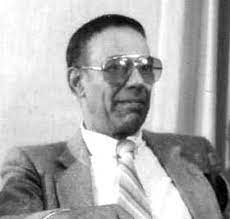
Doug “Jocko” Henderson,
Union Hall, Philadelphia, 1984
at the Blues Music Association’s Awards Presentation
“Jocko” Henderson could have cemented his legacy as a legend had he called it quits in the early 80s. Since the 1950s, Jocko had distinguished himself as a radio superstar at major stations across the East Coast, making him one of the first truly sensational deejays. Always on the pulse of popular music and ahead of the curve, Jocko became a pioneer of rap music from the late 60s into the late 70s with records like 1979’s ‘Rhythm Talk’ and ‘The Rocketship,’ both produced through Philadelphia International Records.
And while this scat-singing, quick-rhyming, “rapping” DJ is today celebrated by notables like Questlove as “unofficially the first MC,” Jocko has another legacy. This other legacy started with an idea he had in 1980: put rap music in the classroom.
The idea of “Get Ready” was to teach kids how to use rap as a tool for memorization and lesson retention. Jocko found that kids absolutely loved rap. He witnessed school kids rapping all 16 minutes of “Rapper’s Delight” by the Sugar Hill Gang word for word.
Then, at a Philadelphia junior high school awards ceremony where Jocko was presenting, something happened. The students clamored for Jocko to “do his raps” from ‘Rhythm Talk’ for them. He gave them what they wanted but found that they already knew all the words. They went on rapping along with him. It was a lightbulb moment for Jocko Henderson, and a year later, Jocko published the very first lesson plan. It was bizarre and new back then, but it felt natural to Jocko.
A phenomenon that opened doors across all corners of society
“See, my father was Superintendent of schools in Baltimore,” Jocko told Smithsonian Productions in a 1995 interview. “So, I’ve lived with educators all my life!”
Indeed, Jocko managed to fund the entire project from his own pockets, and the program took off. The idea was not to get rid of lessons for the students, but rather to supplement their learning with a new system. This system could even go so far as to help kids with learning disabilities. Subjects would range from math to history, from English grammar to applying for a job, including lessons on how to then keep the job. There would even be lessons on how to avoid drugs and alcohol and the dangers of substance abuse.
Within a year, Jocko had his first cassette tape lessons and brochure ready for a pilot school. Within five years, more than 30,000 cassettes had been sold and so had just as many brochures (“manuals”), with many more orders to fill. “Get Ready” was reaching classrooms and offices in all 50 states and the U.S. Virgin Islands, plus the foreign shores of the Bahamas, Ireland, England and Australia.
It didn’t take long for Jocko to declare victory.
By 1981, just a year after the thought occurred to him, he was singing the praises of his own program. “The kids who really disrupt the schools are now very passive,” he said. “It’s unbelievable…the classes that are rapping together, they’re the best of friends now. All the kids are the best of friends. They’re in competition. Who can rap history the best. Who can rap the times table the best. You know? It’s amazing.”
Rapid impact, global resonance, then a mysterious decline
By the late 80s, Jocko Henderson could rest on his educational laurels. Teachers and principals sang his praises for keeping students engaged and ready to come to school. Even students’ grades improved
Young elementary students grew excited for these lessons, which introduced verses like, “A Noun is the name of anything / As school or garden, house or swing” or “An Interjection shows surprise! / As, oh! How pretty! Ah! How wise!” In one Philadelphia junior high school hosting Jocko’s pilot program, attendance rose by nearly 10% in just a few weeks.
In D.C. and Philly, where public outreach to young students was so desperately important, private and public officials found themselves taken by Jocko’s approach, ordering dozens of tapes and manuals. “Get Ready” was in demand. Success was found in youth outreach to career services to on-the-job training for young adults entering the work force. Many found these courses simple, catchy and, most of all, helpful.
“When you apply for a job walk in tall / But remember, don’t be a know it all,” says one rhyme. “Express yourself not too loud but clear. / Let them know you want the job. That’s why you’re there.”
And then, by all accounts, the whole phenomenon went away.
It didn’t end with a bang or a whimper, but it seems to have vanished from curriculums. There appears to be no great failure or controversy. Jocko does not appear to have lost any sleep over it. Up until his death in 2000, he made no complaints nor concerted effort to relaunch the program.
Victory in brevity
What someone might draw from this is that Jocko Henderson succeeded. His program reached students, had quantifiably positive effects and served its purpose
In its wake, programs like Flocabularly and Urban Arts Partnerships’ Fresh Prep Program took over and made massive strides in using rap and hip-hop as teaching tools. Other programs like #HipHopEd, Hip-Hop 101 and Common’s Hip Hop Schoolhouse have launched themselves into the forefront of 21st century rap education. Universities in Arizona and Wisconsin have programs aimed at urban arts, spoken word and degree options, including a hip-hop minor.
To appreciate where we are, we have to look back. And looking back 40 years, we see Douglas “Jocko” Henderson rapping to a classroom of kids, their eyes lighting up, learning becoming an exciting rhythm of fun and Jocko throwing in a line:
“We’re gonna jam jam rebob shebam, / Gonna learn how America became your land!”